PROPAGATION.
On this page you'll find some interesting information on propagation, including the current solar figures.
THE BASICS.
Sunspots.
A sunspot is an area of intense magnetic activity on the surface of the sun which is cooler than the remainder of the sun’s surface.
Sunspots are vital for long distance radio communications.
The more active sunspot groups, the more sunspots the better the dx'ing on the higher HF bands.
Sunspots are vital for long distance radio communications.
The more active sunspot groups, the more sunspots the better the dx'ing on the higher HF bands.
Above:- Sunspots. Image c/o https://flickr.com/photos/24662369@N07/15430820129
Solar Cycle.
Approximately each 11 years the sun enters a cycle of events. When this cycle commences, new sunspots begin to show up on the blank solar disc. Following these first few sunspots, improvement on the higher HF bands becomes noticeable.
Over the years of the cycle, more sunspots start to show, with continued improvement on the HF bands.
The 11 year period of the sunspot cycle is just an average. The cycle can be over a period of 9 years to 15 years.
Solar activity refers to a combination of the amount of sunspots, and the solar geomagnetic activity's effect on the earth’s magnetic field. For the higher HF bands more sunspots usually means improved conditions.
Over the years of the cycle, more sunspots start to show, with continued improvement on the HF bands.
The 11 year period of the sunspot cycle is just an average. The cycle can be over a period of 9 years to 15 years.
Solar activity refers to a combination of the amount of sunspots, and the solar geomagnetic activity's effect on the earth’s magnetic field. For the higher HF bands more sunspots usually means improved conditions.
Solar Flux Index (SFI)
SFI is a figure derived from the number of active sunspots visible on the face of the sun based on observations of thermal and radio noise received at a wavelength of 10.7cm. (2.8GHz). Thermal noise is related directly to the amount of plasma trapped in the magnetic field in active regions of the sun, this is related to the amount of magnetic flux generated by these active regions. The higher the SFI the better for dx'ing on the higher HF bands.
Smoother Sunsport Number (SSN)
When we plot the daily sunspot numbers, it's goes up and down all over the place. so smart people came up with a way to average out the bumps, called ‘smoothing’, which gives us the SMOOTHED SUNSPOT NUMBER or SSN. In the years where there are few sunspots, propagation on the higher bands can be nonexistent. It's not all bad news though as things on the low bands tend to improve with decline in solar activity. Again larger SSN numbers mean better conditions on the higher HF bands.
A & K Index.
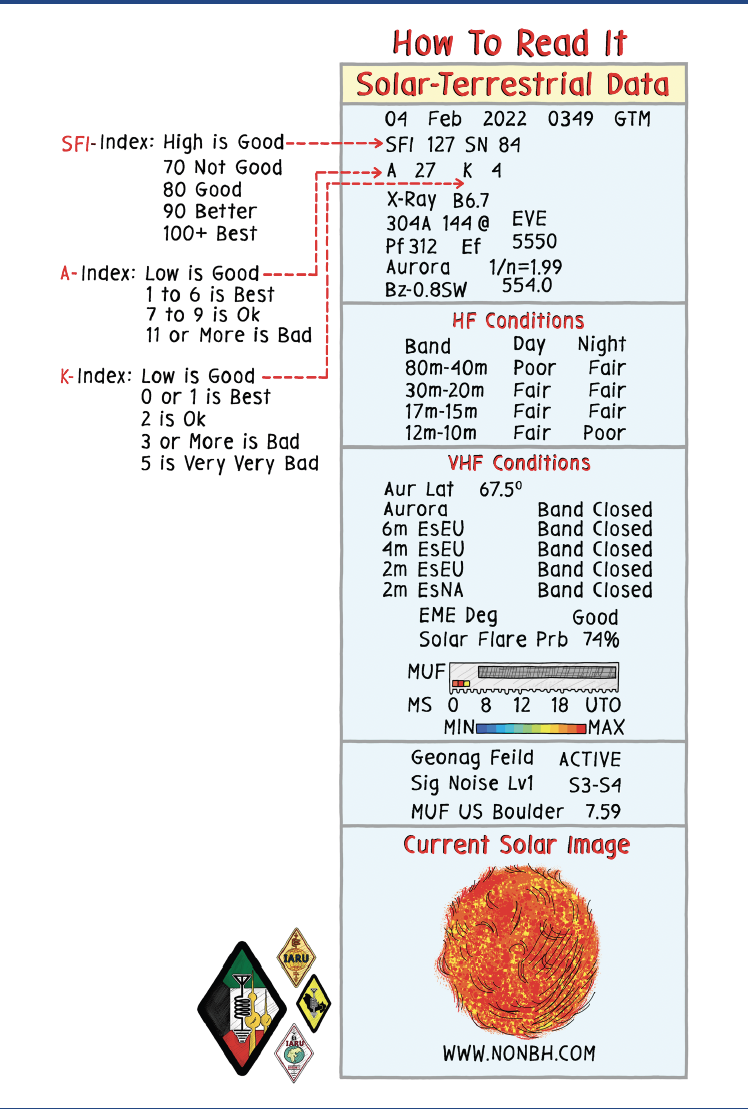
When talking about the solar cycle the numbers are based on ‘smoothed’ numbers, this means the monthly average rather than the figures for each day. Using 'smoothed' numbers gives more accurate results, daily solar activity varies dramatically, making accurate results difficult. A and K INDEX are measurements of the magnetic field activity that are used in predictions.
The K index is a reading of the magnetic activity as compared to a ‘quiet’ day made from various locations. This index in the range 0-9. The K index is the average of of these readings.
CURRENT SOLAR FIGURES.
UNDERSTANDING HF PROPAGATION.
THE ATMOSPHERE.
THE SOLAR CYCLE.
SOLAR FLARES.
AURORA.
HOW TO INTEPRET SOLAR DATA.
THE CARRINGTON EVENT.
SOME HELPFUL VIDEOS.
WEBSITES.
Space Weather Prediction Center.
ARTICLES.
"Radio, Ionosphere, Magnetism, and Sunspots", by Leif Svalgaard
| radio-and-sunspots.ppt | |
| File Size: | 29047 kb |
| File Type: | ppt |
"Amateur Radio Frequency Propagation" by Jerry VerDuft AD0A
| amateur_radio_frequency_propagation.ppt | |
| File Size: | 3741 kb |
| File Type: | ppt |
Understanding HF propagation reports
| understanding-hf-propagation-reports.pdf | |
| File Size: | 211 kb |
| File Type: | |
Introduction to HF propagation - IPS Radio and Space Services
| intro_to_hf_radio_propagation__1_.pdf | |
| File Size: | 521 kb |
| File Type: | |
Space Weather. Storms from the Sun
| space_weather.pdf | |
| File Size: | 4328 kb |
| File Type: | |
Solar activity & HF propagation.
| fdim81.pdf | |
| File Size: | 779 kb |
| File Type: | |
References.
- Dave G4AKC