PATRON SAINT OF AMATEUR RADIO.
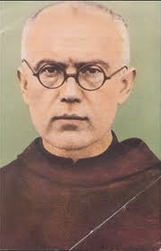
In 1903, Kolbe saw a vision of the Virgin Mary. Four years later, he and his elder brother Francis joined the Conventual Franciscans. He chose a religious name, Maximillian. Following his final vows in 1914, he adopted the additional name of Maria. In 1918, Kolbe was ordained as a priest. (Wikipedia 2019)
Between 1930 and 1936, Kolbe undertook a series of missions to Southeast Asia, including China, Japan, and India, to establish monasteries. It was whilst he was in Japan that Kolbe became aware of a network of small broadcasting stations. (Hamgallery.com, 2025)
Kolbe decided to establish a radio station as a new medium to supplement the religious periodicals that he was publishing in Poland and abroad. (Hamgallery.com, 2025)
In 1930, Kolbe applied for a radio broadcasting license in Poland. At that time, only Radio Warsaw and a military station existed. (Hamgallery.com, 2025)
In 1936, Kolbe returned to Poland, where he spoke on Polish radio on two occasions in December 1937 and February 1938. Kolbe sent Brother Manswet Marczewski to a radio course conducted by the Warsaw Amateur Radio Club. (Hamgallery.com, 2025)
On the 28th day of October 1938, a radio licence for test broadcasting was issued. In December 1938, a test broadcast was heard from the station whose call-sign was spelt Stacja Polska 3 Radio Niepokalanów - SP3RN. (Hamgallery.com, 2025)
Kolbe decided to establish a radio station as a new medium to supplement the religious periodicals that he was publishing in Poland and abroad. (Hamgallery.com, 2025)
In 1930, Kolbe applied for a radio broadcasting license in Poland. At that time, only Radio Warsaw and a military station existed. (Hamgallery.com, 2025)
In 1936, Kolbe returned to Poland, where he spoke on Polish radio on two occasions in December 1937 and February 1938. Kolbe sent Brother Manswet Marczewski to a radio course conducted by the Warsaw Amateur Radio Club. (Hamgallery.com, 2025)
On the 28th day of October 1938, a radio licence for test broadcasting was issued. In December 1938, a test broadcast was heard from the station whose call-sign was spelt Stacja Polska 3 Radio Niepokalanów - SP3RN. (Hamgallery.com, 2025)
Kolbe broadcast the following message:
“This station [SP3RN] can be found on your receivers outside the Polish amateur radio band 41.4m, between 41.1 and 41.4m. ... Allegedly, there are 50,000 amateur radio operators. Some will listen out of curiosity, others out of sadness.” (Pronechen 2022)
Above:- SP3RN. Image c/o Ave Maria Facebook page.
Following the outbreak of the Second World War, Kolbe was one of a handful of friars who remained in the monastery. (Wikipedia 2019)
On the 19th day of September 1939, Kolbe was arrested by the Germans, but was released by December and continued his work at his friary. He provided shelter to refugess from Greater Poland including about 2,000 Jews who he hid from the Nazis. (Wikipedia 2019)
The monastery continued to produce publications that were considered anti Nazi, and was closed by the Nazis in February 1941. That month, Kolbe and four others were arrested by the Gestapo and the radio station was closed down. Kolbe was imprisoned at Pawiak Prison and transferred to Auschwitz on the 28th day of May 1941. (Wikipedia 2019)
Whilst in Asuchwitz, Kolbe continued to act as a priest and was subjected to regular beatings and lashings at the hands of the Nazis. (Wikipedia 2019)
In July 1941, a prisoner escaped from the camp. As a deterrent for further escapes, the Nazi Commandant chose ten men to be starved to death in an underground bunker. One of those was a Polish Catholic, Franciszek Gajowniczek. (Wikipedia 2019)
Upon being chosen, he cried out, 'My wife! My children!". Kolbe stepped forward and volunteered to take his place, which was accepted.
Above:- Franciszek Gajowniczek's photo from Auschwitz. Image c/o WIkipedia.
According to reports, whilst in the bunker, Kolbe led the prisoners in prayer. On each occasion that the Nazi guards checked, Kolbe was standing or kneeling in the middle of the cell. After two weeks of being deprived of any food or water, only Kolbe and three others were still alive. (Wikipedia 2019)
The bunker was required for other purposes. Kolbe and the three other men were then murdered by the Nazis, who gave lethal injections of carbolic acid. Kolbe died on the 14th day of August 1941, aged 47 years old. He was cremated in the Auschwitz crematorium the following day without any ceremony or dignity. (Hamgallery.com, 2025)
On 17 October 1971, Maximilian Kolbe was beatified for his martyrdom by Pope Paul V1 in the Vatican. Franxiszek Gajowniczek, who survived the Holocaust, was a special guest. (Wikipedia 2019)
On the 10th day of October 1982, Kolbe was canonised by Pope John Paul II as Saint Maximillian Kolbe, Apostle of Consecration to Mary and declared a Martyr of charity. He is considered the Patron saint of Amateur radio operators. (Wikipedia 2019)
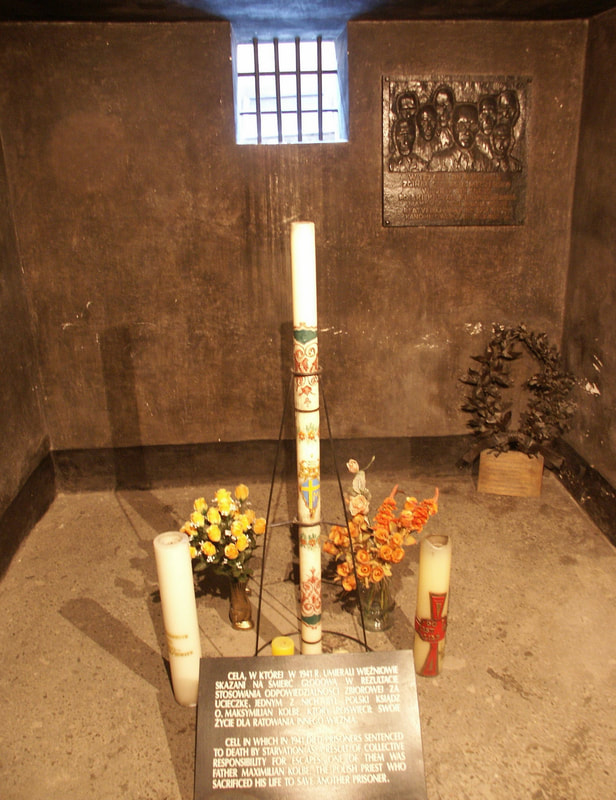
Above: Maximilian Kolbe's prison cell at Auschwitz. Image c/o Dnalor-01, WIkipedia Commons, (CC-BY-SA 3.0)
Gajowniczek died in March 1995 at the age of 93. This was 53 years after his life was saved by Kolbe. (Wikipedia 2019)
In 1998, an amateur radio net entitled the 'Saint Maximilian Kolbe Net' was founded to commemorate the life of Kolbe. The net was established by Dr. Ted Figlock W1JMJ (SK) and Lloyd Roach K3QNT.
VIDEOS.
References.
- Hamgallery.com. (2025). St. Maximilian Maria Kolbe - SP3RN. [online] Available at: https://hamgallery.com/Tribute/SP3RN/ [Accessed 30 Jun. 2025].
- Pronechen, J. (2022). Roger That! Did You Know That St. Maximilian Kolbe Is the Patron of Amateur Radio Operations? [online] NCR. Available at: https://www.ncregister.com/features/roger-that-did-you-know-that-st-maximilian-kolbe-is-the-patron-of-amateur-radio-operations [Accessed 30 Jun. 2025].
- Saintmaxnet.org. (2023). Saint Max Net. [online] Available at: https://www.saintmaxnet.org/ [Accessed 30 Jun. 2025].
- Wikipedia Contributors (2019). Maximilian Kolbe. [online] Wikipedia. Available at: https://en.wikipedia.org/wiki/Maximilian_Kolbe.[Accessed 30 Jun. 2025].
- Wikipedia. (2020). Franciszek Gajowniczek. [online] Available at: https://en.wikipedia.org/wiki/Franciszek_Gajowniczek. [Accessed 30 Jun. 2025].